Staubbach Falls in Lauterbrunnen: Walk, Gallery and Photo Spots
 +12
+12Staubbach Falls is the 297-metre waterfall that drops straight off the cliff above the village of Lauterbrunnen, and it is the picture most people have in mind when they think of the Lauterbrunnen Valley. It costs nothing to visit, you can walk to its foot from the station in about ten minutes, and from May to October a short path with a tunnel and stairs takes you up into a rock gallery right next to the falling water. We spent the afternoon of July 6, 2026 there with our dog Miley, and we came past again on the evening of July 9. This guide covers the walk, the gallery, the church, the best photo spots and what we would do differently.
Staubbach Falls at a glance
| Height | 297 m (974 ft), Switzerland’s highest free-falling waterfall |
|---|---|
| Location | Lauterbrunnen village, Bernese Oberland, about 10 minutes on foot from the station |
| Entry | Free, no ticket needed |
| Gallery path | Open May to October, closed in winter |
| Walk | About 30 minutes up and down from the foot of the falls, with a tunnel and stairs |
| Best season | Late spring and early summer, when snowmelt feeds the stream |
| Evenings | The falls are lit up in summer |
| Parking | Parkhaus Lauterbrunnen, CHF 18 for 8 hours (about US$22) |
| Time needed | 1 to 2 hours including the church and the gallery |
Sources: lauterbrunnen.swiss, jungfrau.ch, myswitzerland.com. US dollars at 1 CHF = 1.21 USD (October 2026).
- Is Staubbach Falls worth visiting?
- How high is Staubbach Falls?
- How to get to Staubbach Falls
- The walk to the falls: meadow, tunnel and stairs
- The gallery behind the waterfall
- Lauterbrunnen church and the classic view
- The best photo spots
- Goethe and the Song of the Spirits over the Waters
- Best time to visit
- Staubbach Falls with a dog
- Our afternoon at the falls
- What to combine it with
- Tips from our visit
- FAQ
Is Staubbach Falls worth visiting?
Yes. Staubbach Falls is free, it is right in the village, and in one or two hours you get the most famous view of the Lauterbrunnen Valley, a short walk up to the falls and a look down over the whole valley floor. It combines easily with anything else in the valley.
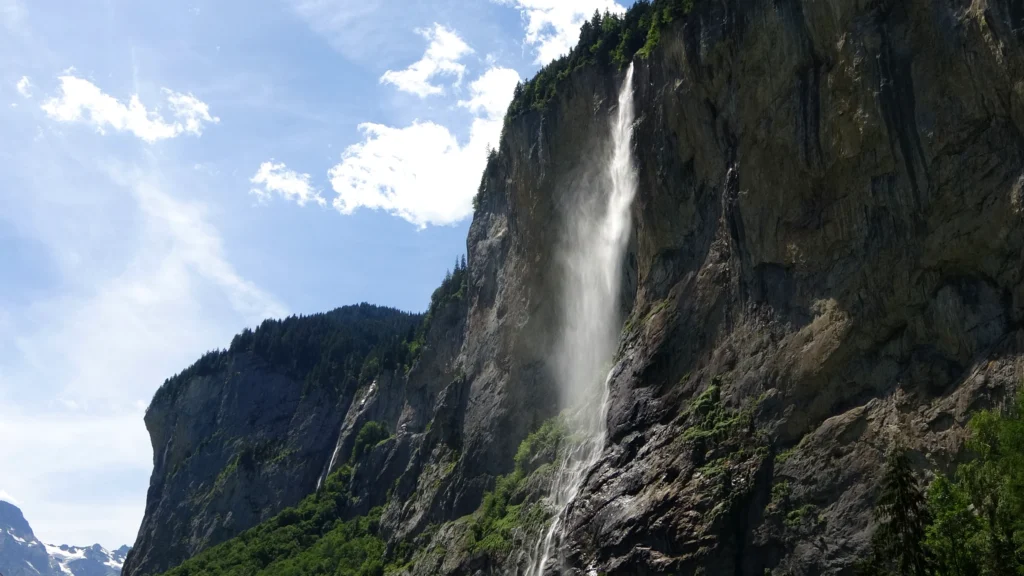
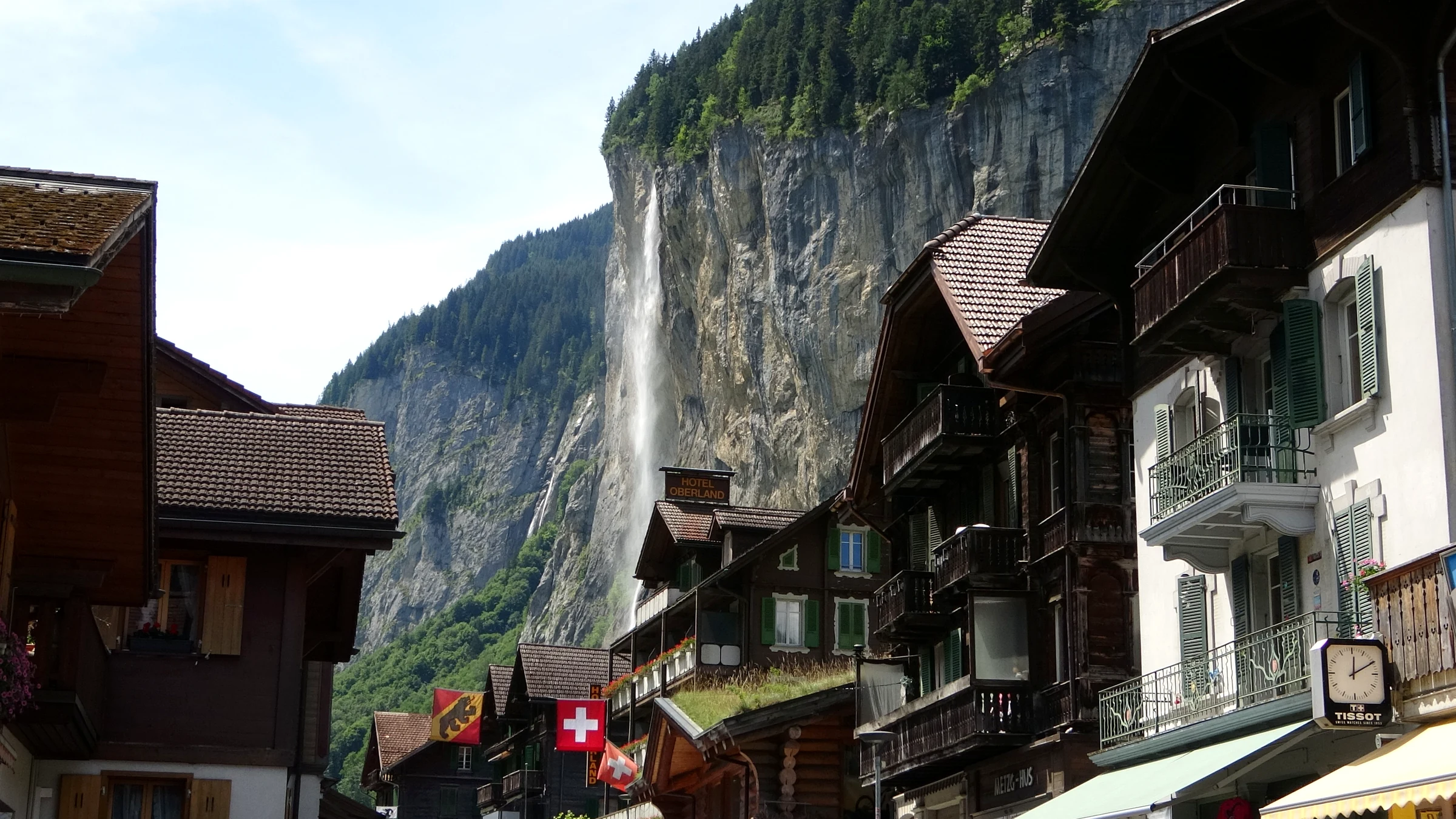
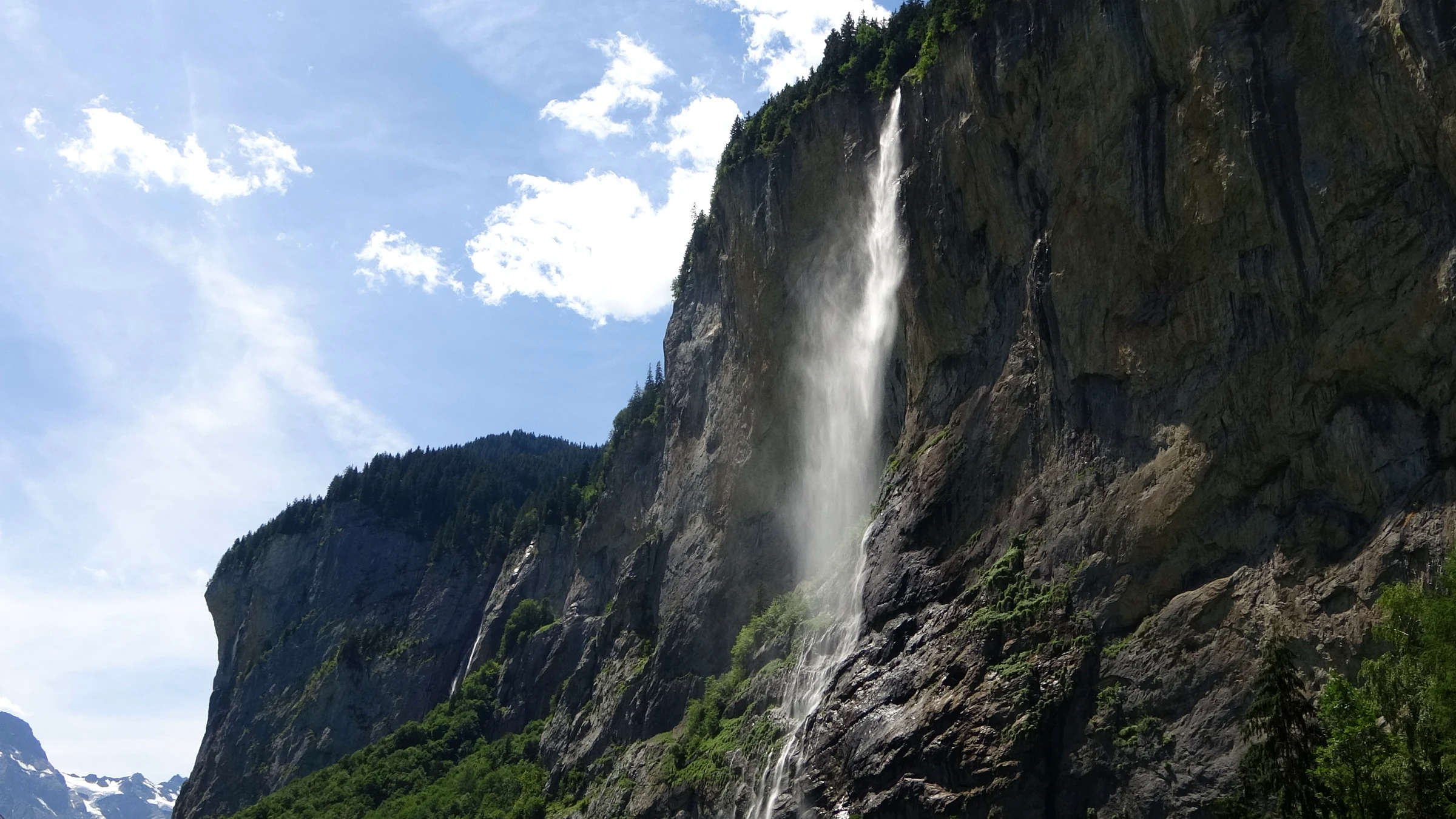
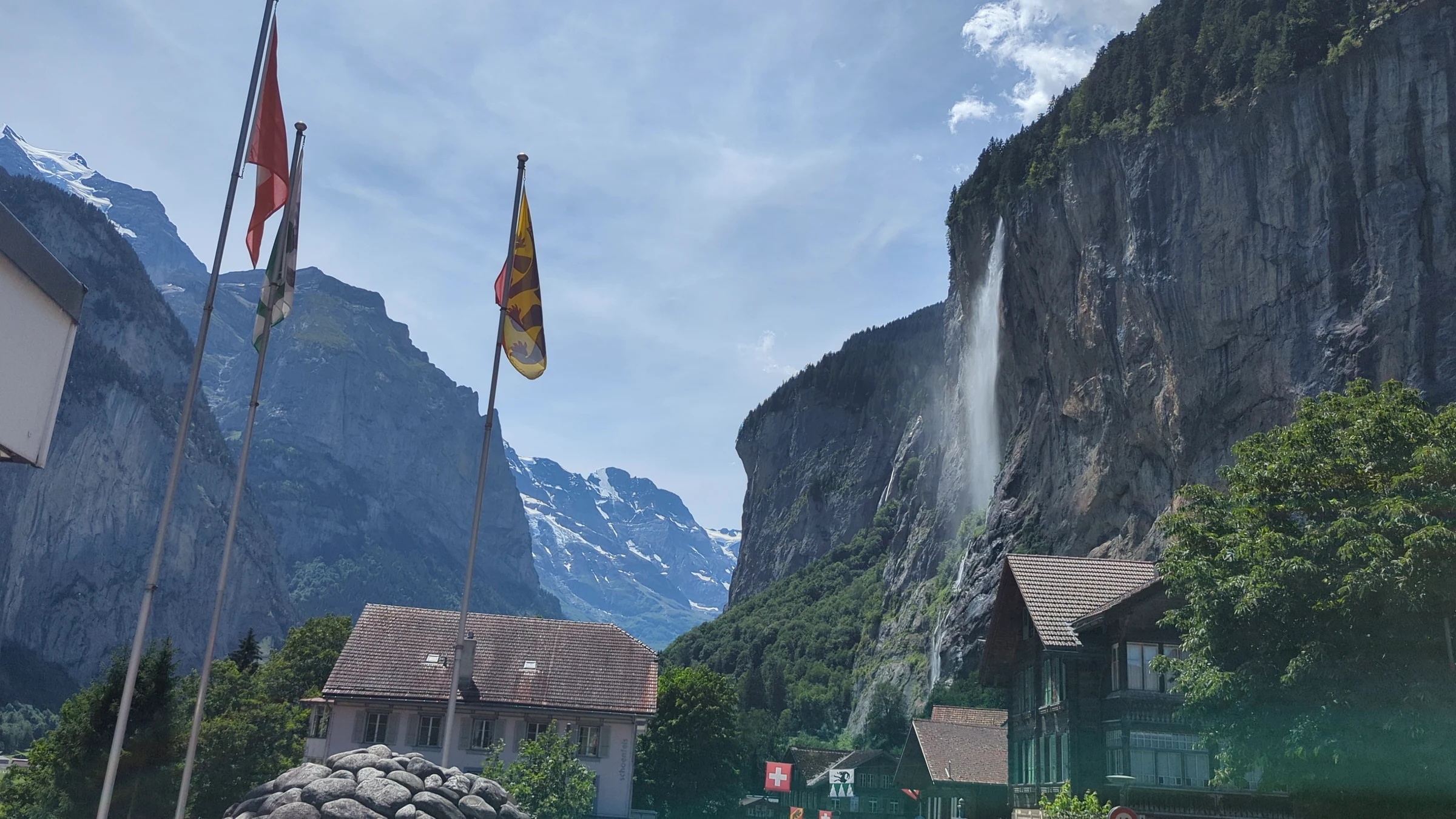
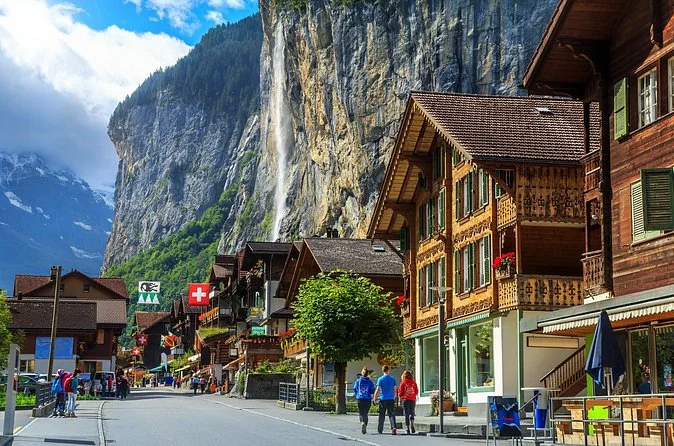
What makes it special is the way the water falls. The stream comes over the edge of an overhanging cliff and drops freely through the air, so by the time it reaches the bottom much of it has turned into fine spray that drifts in the wind. From the main street the falls look like a white ribbon hanging behind the chalets, and the closer you get, the more you feel the cold mist on your face.
Do not expect a thundering wall of water like at the Rhine Falls. Staubbach is about height and setting, not volume, and in a dry late summer it can shrink to a thin veil. When we were there at the beginning of July, there was plenty of water and the spray drifted well beyond the foot of the cliff.
How high is Staubbach Falls?
Staubbach Falls is 297 metres high (974 feet), and the local tourist office calls it the highest free-falling waterfall in Switzerland. The Mürrenbach Falls further up the valley are counted as the country’s highest waterfall overall, but they come down in several steps, while the Staubbach makes one single free drop.
The stream comes out of a hanging valley above the cliff, and because the rock overhangs at the top, the water leaves the rock and falls through open air. That is also where the name comes from: Staub means dust in German, and the falls are named after the dust-like spray they turn into. The amount of water depends heavily on the season and the weather. It is highest in late spring and early summer when the snow melts, and after heavy rain. In winter the falls sometimes freeze.
The falls have been famous for a long time. The Swiss painter Caspar Wolf painted them in the 1770s, and they were shown on a Swiss stamp in the 1930s.
How to get to Staubbach Falls
Walk from Lauterbrunnen station along the main street towards the end of the village; the foot of the falls is about ten minutes away and you see the waterfall the whole time. By car, park in the Parkhaus Lauterbrunnen next to the station or at the smaller church car park.
- By train: Interlaken Ost to Lauterbrunnen takes about 20 minutes, with trains every 30 minutes. From the station, walk up the main street past the hotels and shops. The falls are on your right.
- Parkhaus Lauterbrunnen: Zuben 479, 3822 Lauterbrunnen. 974 spaces, open around the clock all year, CHF 18 for 8 hours (about US$22). Payment by cash, card or Twint.
- Car park by the church: Pfrundmatte 423, 3822 Lauterbrunnen. 168 spaces, CHF 12 for 8 hours (about US$15). It is the closest to the falls, but when we passed at 13:56 it was full of cars and campervans.
We left the car in the Parkhaus on level 3 and walked. For everything else about the village itself, from parking in high season to where to eat, see our Lauterbrunnen Valley guide.
The walk to the falls: meadow, tunnel and stairs
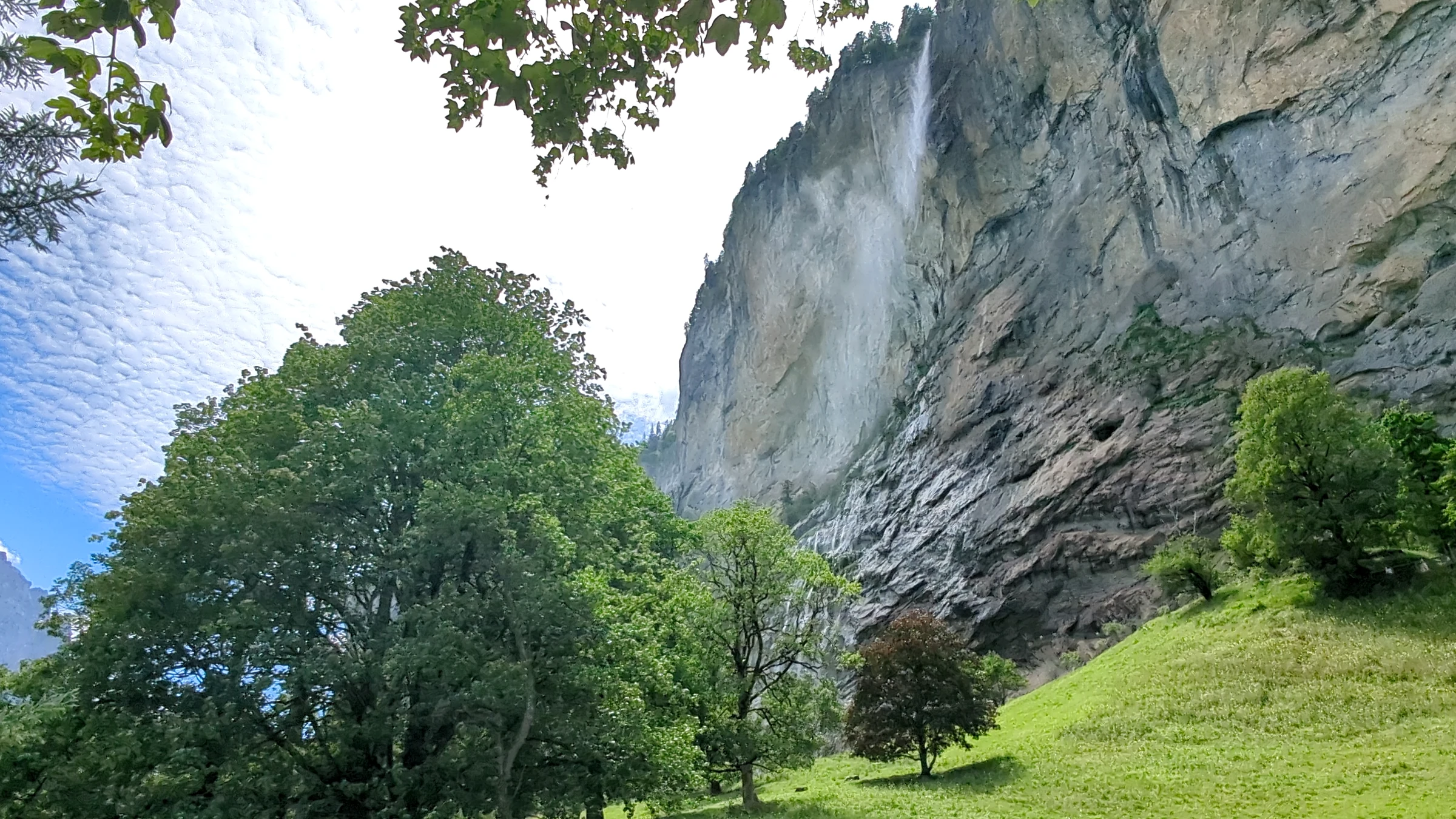
From the church, a paved path crosses a meadow to the foot of the falls. From there a footpath climbs in about ten minutes to a small hill, the Staubbachhubel, then goes through a tunnel and up stairs to the gallery at the rock face. The whole loop up and back takes about 30 minutes without stops.
The paved section to the foot of the falls is flat and fine for strollers. After that it gets steeper. The path to the Staubbachhubel is a well-kept footpath with a few steps. On the way, a boulder carries a bronze plaque with Goethe’s poem about the falls.
Above the Staubbachhubel the path disappears into the hillside. The tunnel is a round tube of corrugated steel, lit with lamps, and the entrance is plastered with hundreds of stickers left by visitors. A sign at the entrance says the lighting is switched off between 20:00 and 8:00, so bring a phone torch if you go late. After the tunnel, stairs and a secured path lead up to the rock face.

The climb is short but steep in places, and the steps are wet from the spray near the top. Trainers with good grip are enough. With small children it is doable, but keep them close on the stairs.
The gallery behind the waterfall
The Staubbach gallery is a walkway with a railing built into the rock niche at the foot of the cliff, next to and partly behind the falling water. It is open from May to October and free of charge. From up here you look out over the whole Lauterbrunnen Valley while the spray drifts past you.
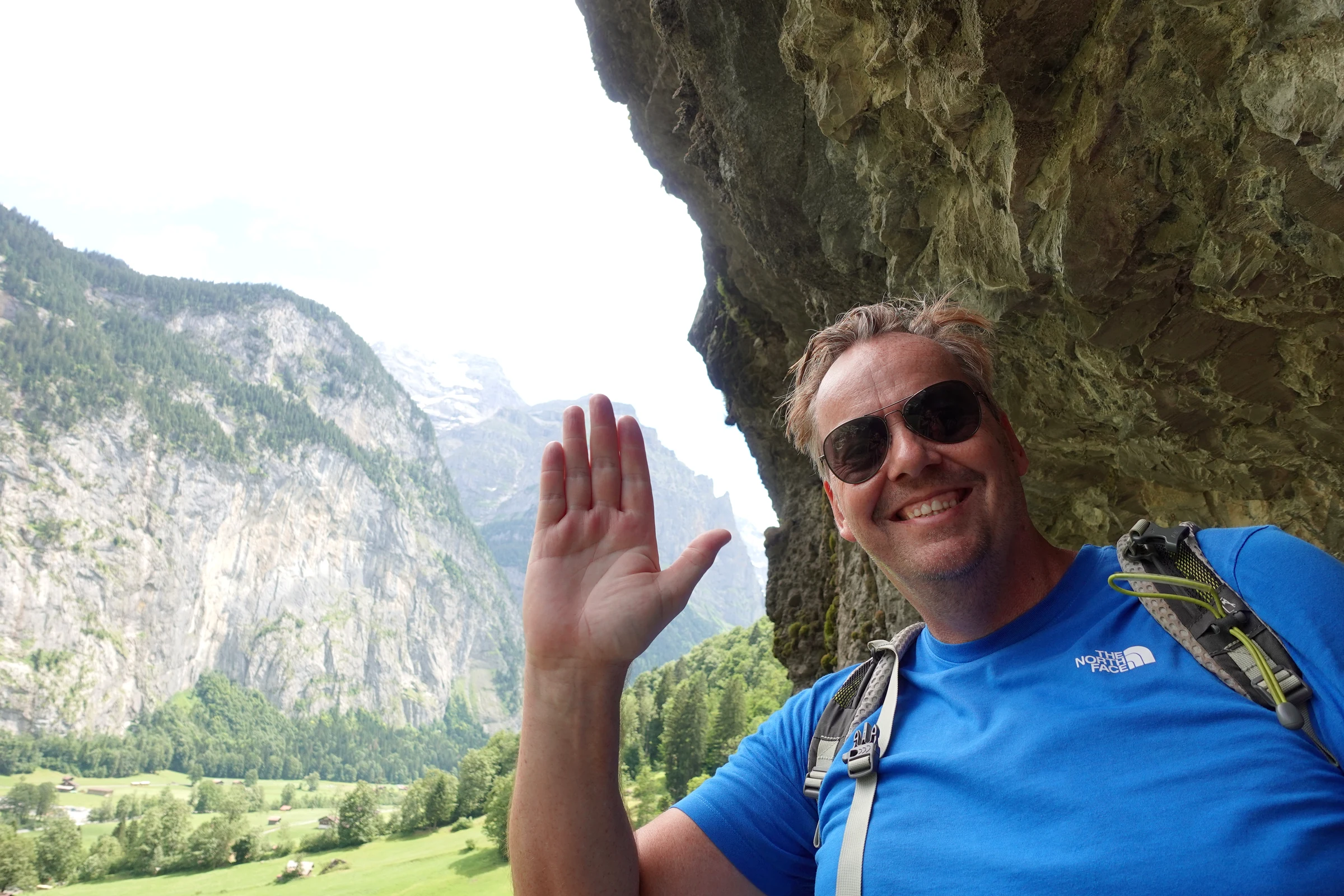
When we reached the gallery at 14:29, the view was what stayed with us more than the waterfall itself. The rock overhang frames the valley like a window: the green valley floor with its scattered chalets, the steep cliffs on the opposite side and, at the end of the valley, the snow-covered peaks. The walkway is narrow, with room for only a few people at the railing at a time, so at busy times expect to wait a moment for your turn.
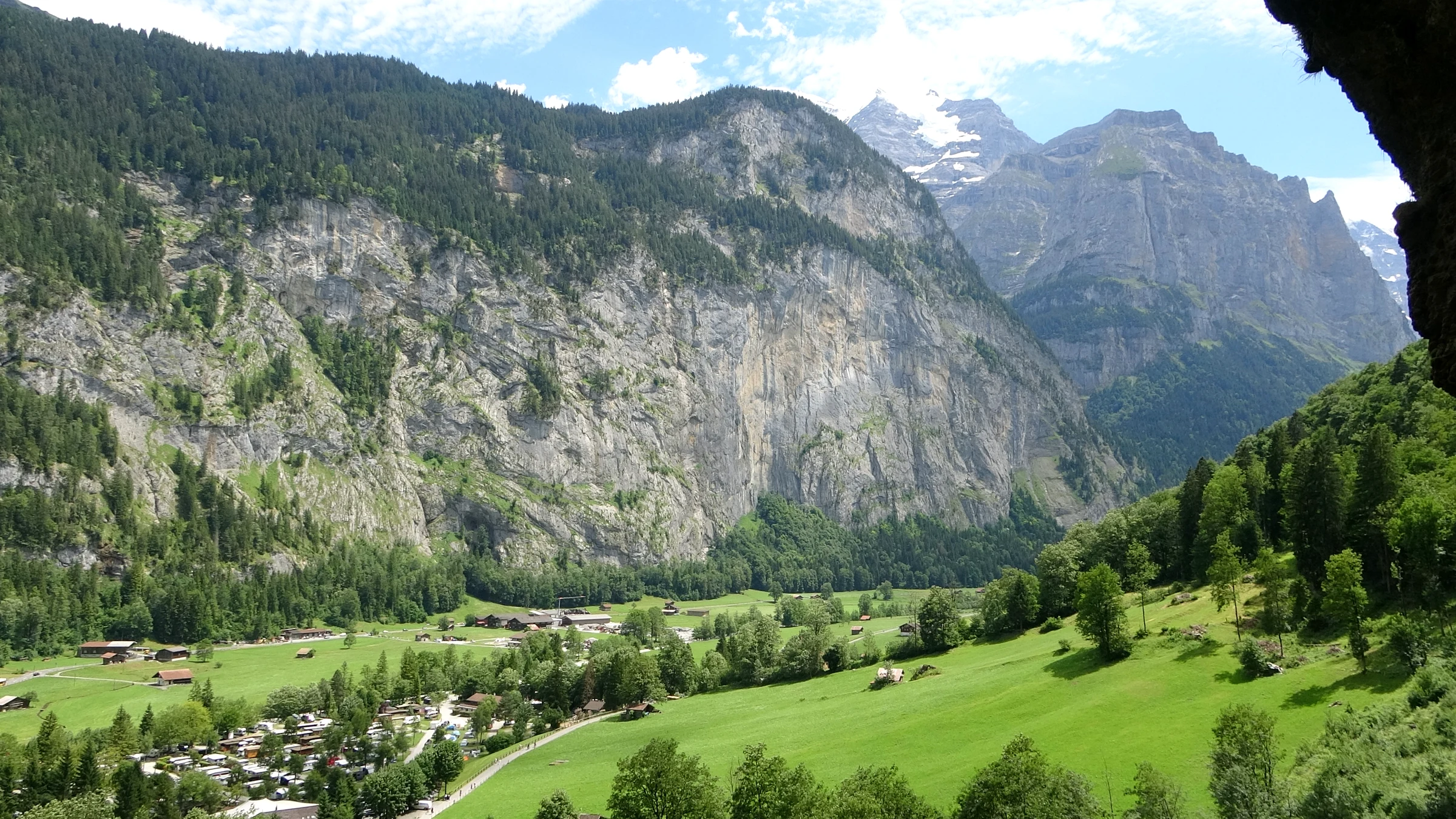
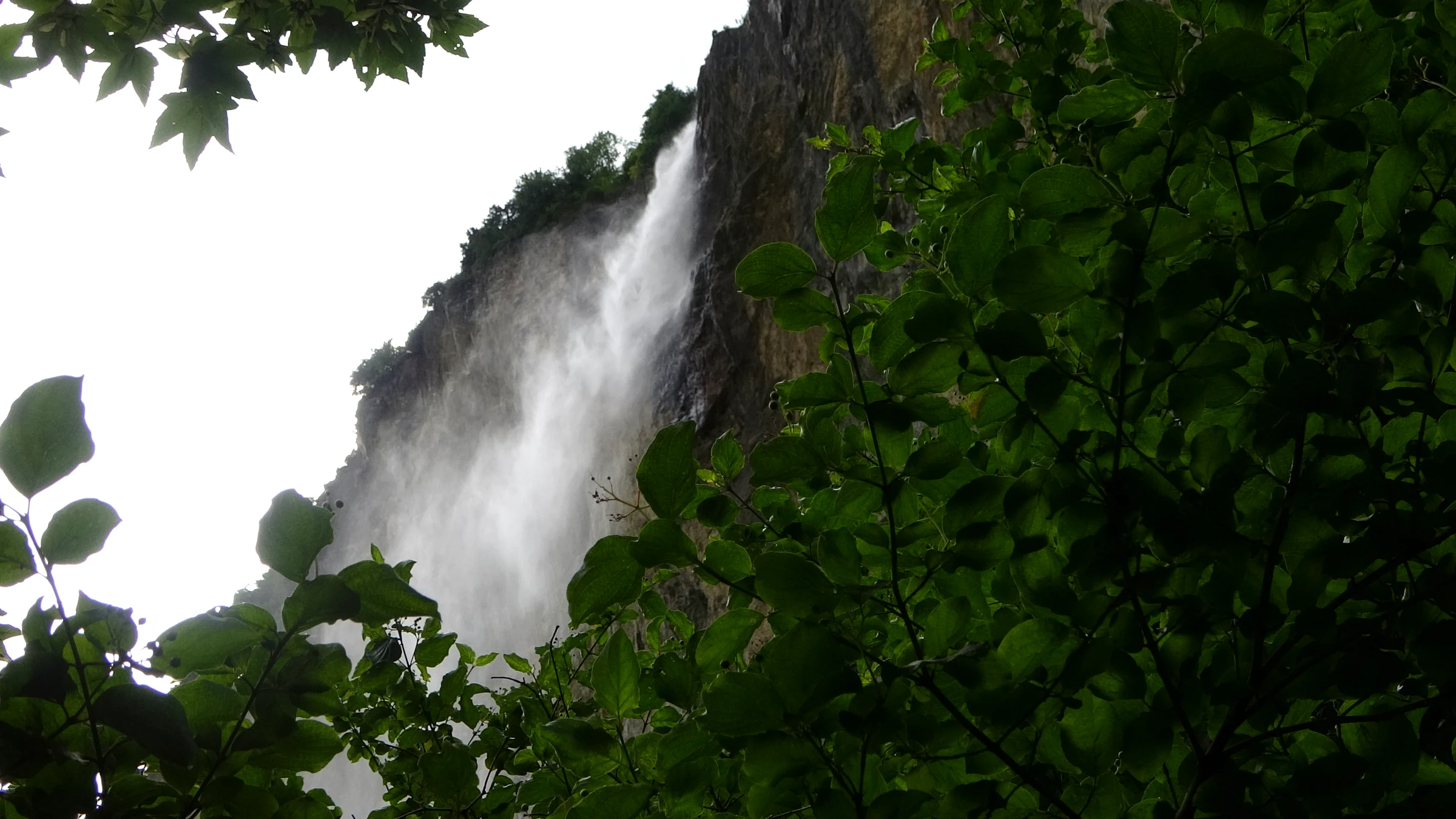
Expect to get wet. How much depends on the wind and the amount of water, and at the beginning of July there was a lot of both. Bring a lens cloth and a light rain jacket. On the way down, there is a spot below the falls where you stand right in the mist and look straight up the column of water. That is where we took our most dramatic photos.
The gallery is closed from November to April. In winter you can still see the falls from the village and walk to the foot.
Lauterbrunnen church and the classic view
The white Reformed church with its pointed dark tower stands right below the falls, and together they make the classic Lauterbrunnen picture. It was open when we visited, and a short look inside is worth it.
The valley people built their first church here in 1487 and 1488, even before the monastery that ruled the area gave its permission. After the Reformation in 1528, Lauterbrunnen became its own Reformed parish. Inside, the church is bright and simple: white walls, a warm wooden ceiling, stained glass windows, wooden pews and an organ at the front. When we went in at 13:00, we had it almost to ourselves, while the street outside was full of people.
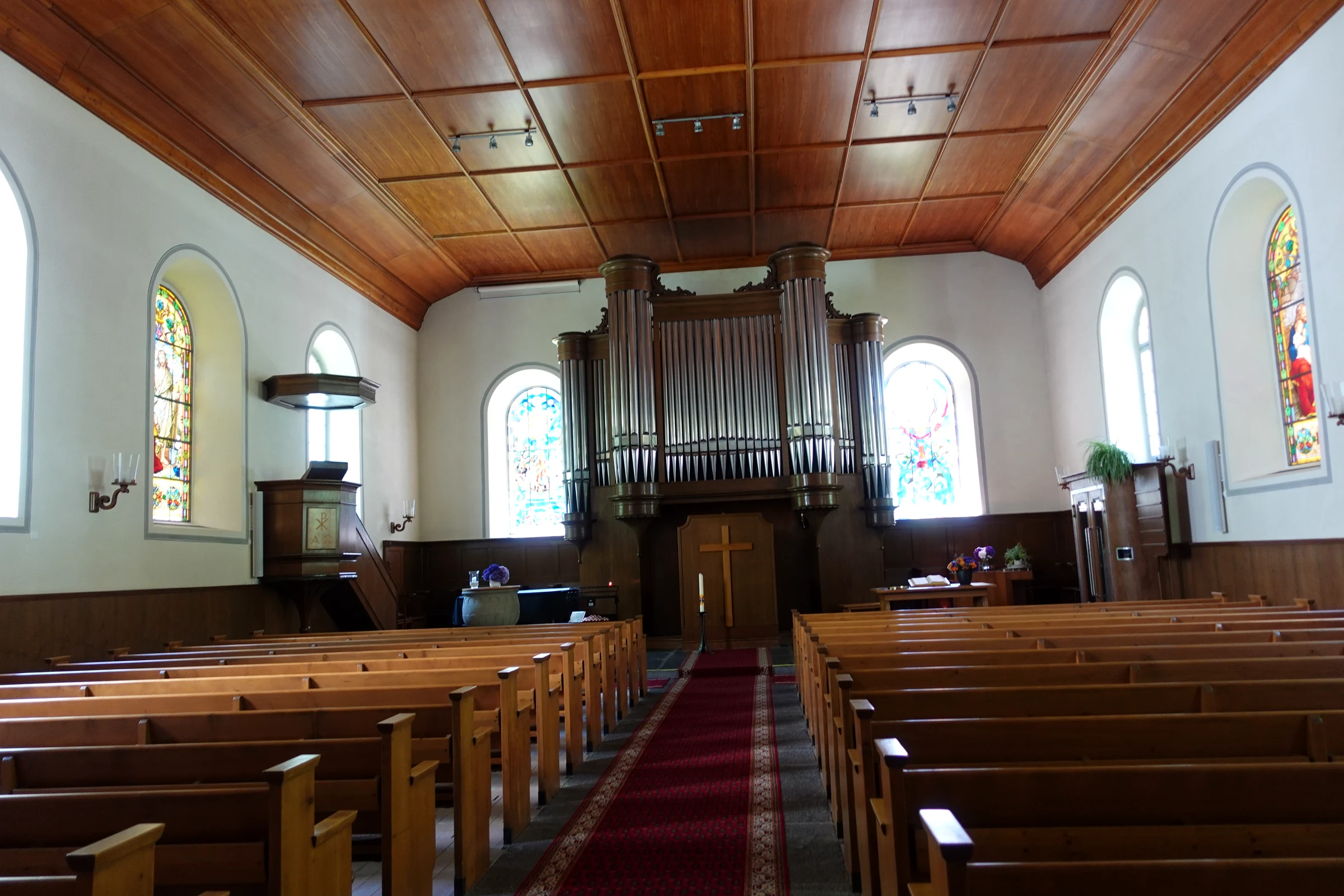
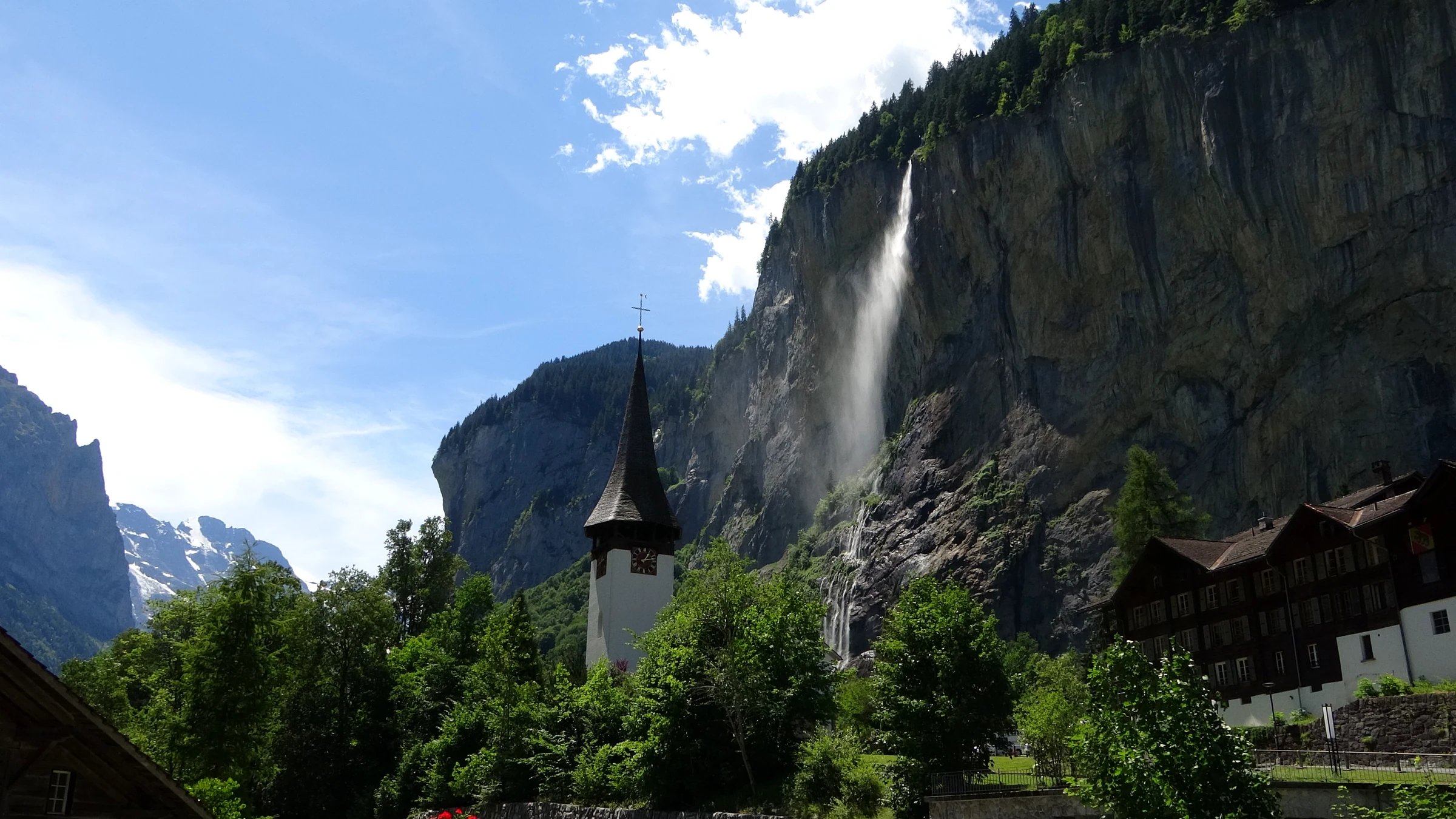
It is a working church, so keep your voice down. For the classic photo of church and waterfall, walk past the church towards the meadow and look back. Low walls and gardens give you foregrounds, and the tower lines up with the falls from several angles.
The best photo spots
The best photos of Staubbach Falls come from five places: the main street, the area around the church, the meadow at the foot of the falls, the Staubbachhubel and the gallery itself. All are within a 15-minute walk of each other.
- Main street: the falls rise behind the wooden hotel fronts with Swiss flags. Best in the late morning, when the sun is on the houses.
- Church and garden: the classic composition of tower and waterfall. Shoot with a wide lens from the lower path.
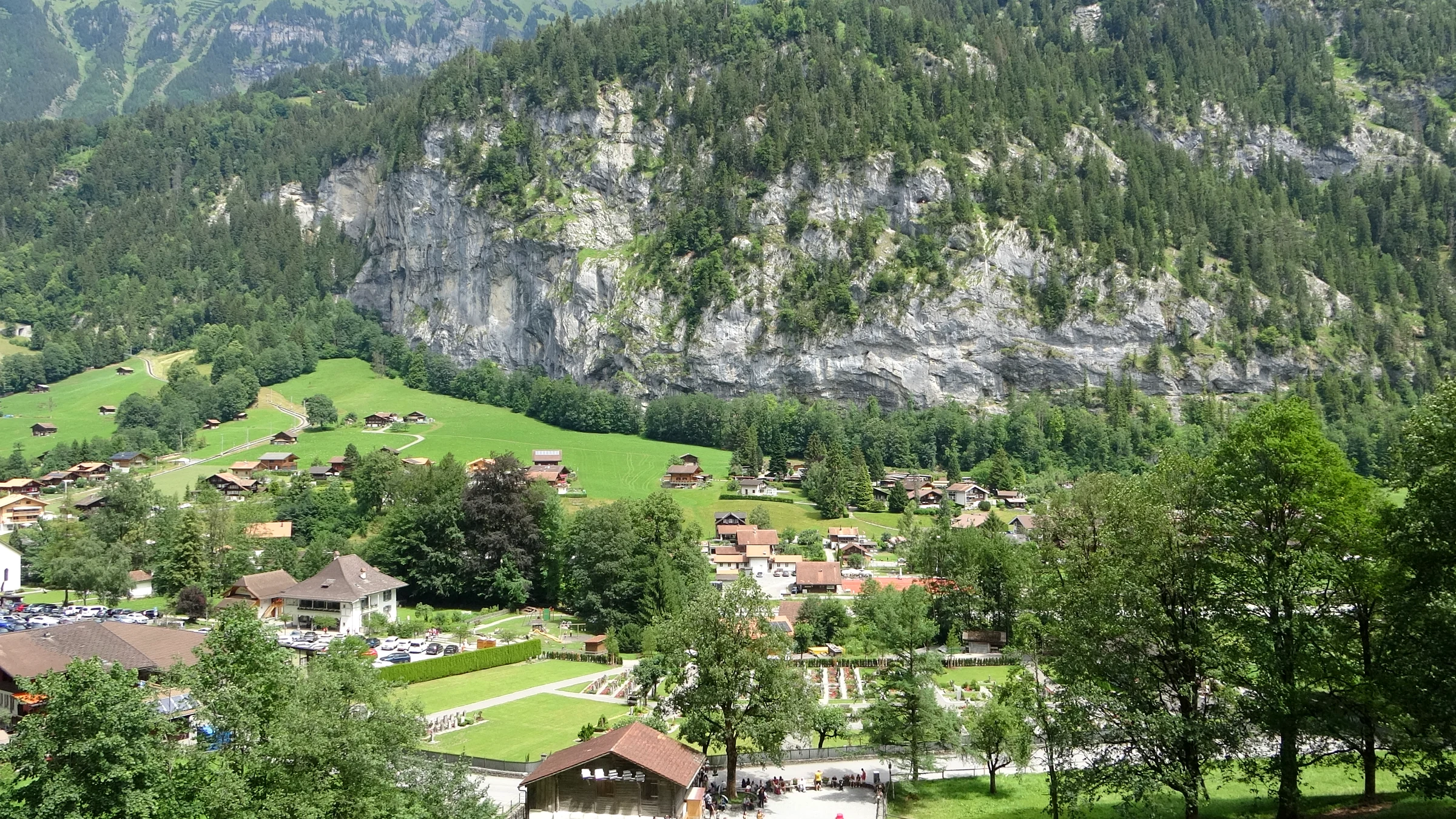
- Staubbachhubel: the best place for an overview of the village with the church, the meadows and the cliffs on the far side.
- Below the gallery: stand in the spray and shoot straight up the water. Protect your camera.
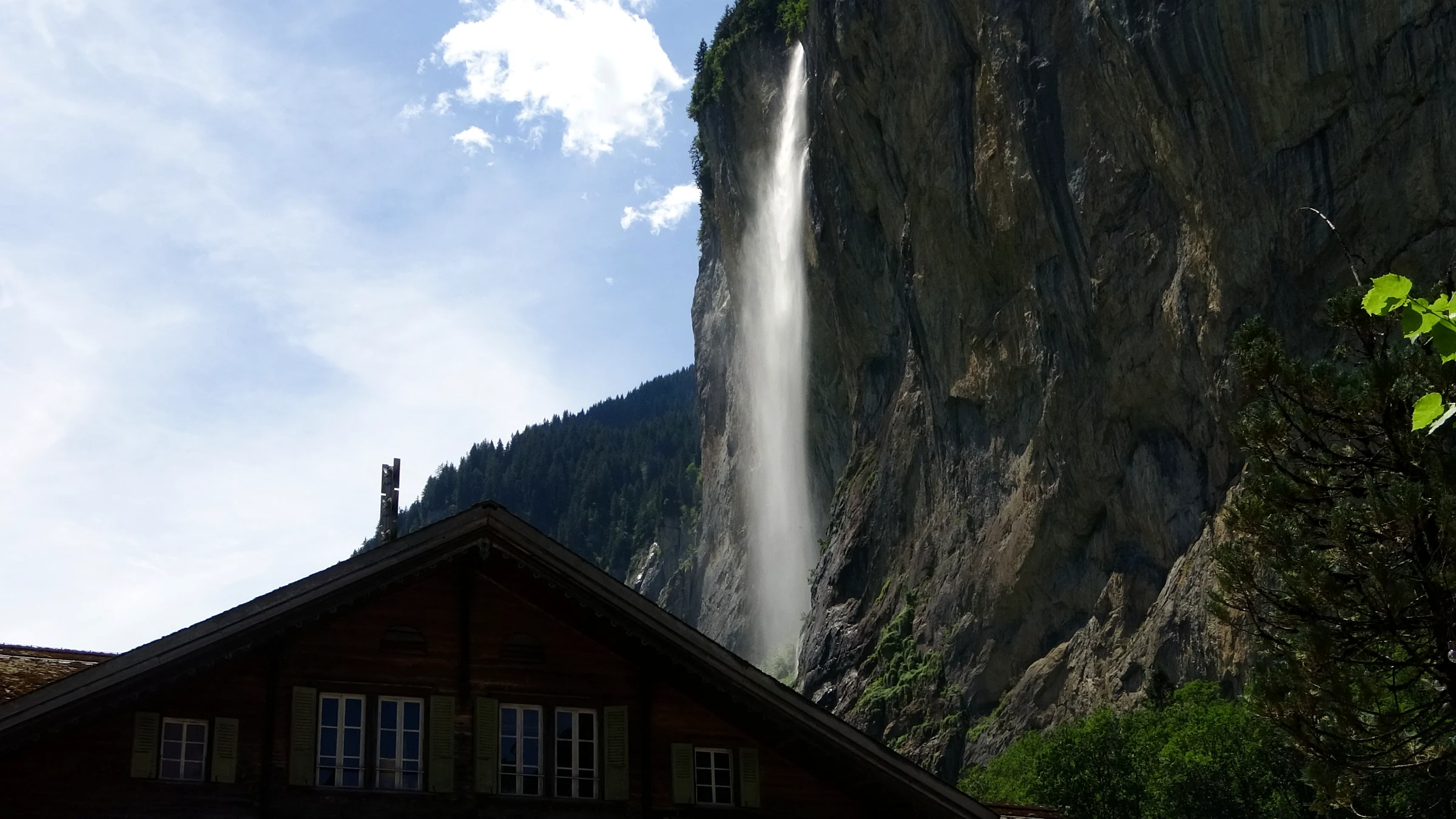
The light changes a lot over the day. In our photos the water and the rock looked brightest between late morning and early afternoon. Later, with the sun behind the cliff edge and the sky bright, the falls looked darker and flatter from below. If you only have one slot for photos, go before 14:00.
Near the foot of the village a row of flagpoles with the Swiss and Bernese flags, plus the snowy peaks at the end of the valley, makes a very Swiss photo.
On the Staubbachhubel, turn around: the view over the village is the reason to stop.
Goethe and the Song of the Spirits over the Waters
Johann Wolfgang von Goethe stayed in Lauterbrunnen from October 9 to 11, 1779, during his second journey through Switzerland, and the Staubbach Falls inspired one of his best-known poems, Gesang der Geister über den Wassern (Song of the Spirits over the Waters). A plaque on a boulder along the path to the falls carries the full text.
The poem compares the human soul to water: it comes from heaven, rises to heaven and must return to earth, forever changing. Its first lines are carved in bronze on the stone: “Des Menschen Seele gleicht dem Wasser” (the soul of man is like the water). Goethe wrote the first version under another title and published it in its final form in 1789. Franz Schubert set it to music several times, the best-known version for eight male voices and strings.
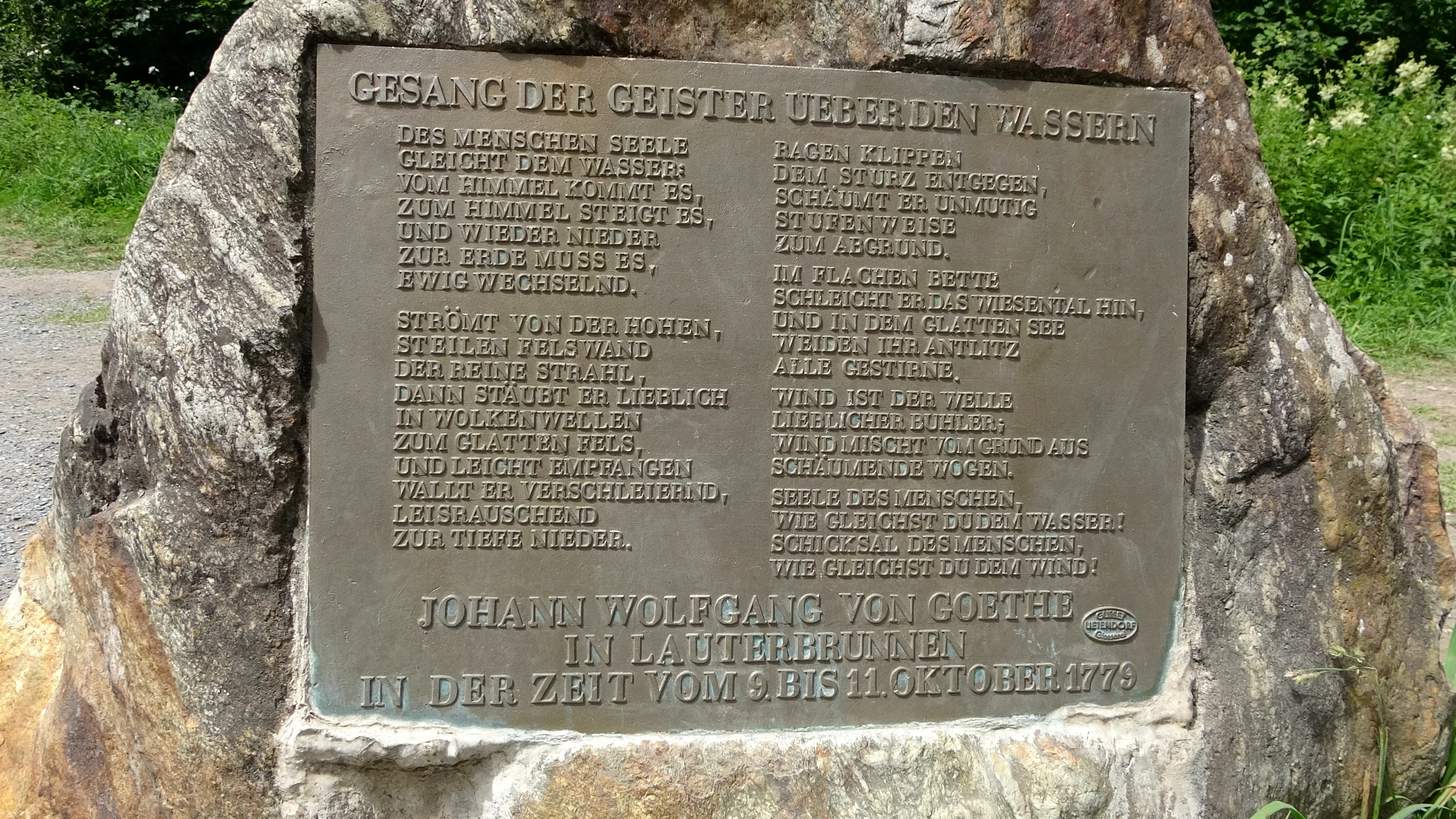
Take a minute here: standing there with the spray drifting over the meadow, you understand what Goethe meant with the water that “rises to heaven” as mist.
Best time to visit
The best time to visit Staubbach Falls is from late May to early July, in the morning, on a day after rain. Then the falls carry the most water, the cliff is in the sun and the village is still quiet.
- Season: May and June bring the most meltwater. In a dry August or September the waterfall can become thin. The gallery is open from May to October.
- Time of day: on our visit the main street got busier from midday, and at 16:00 it was crowded. Early morning is your best chance of a quiet walk.
- Evening: in summer the falls are lit in the evening. We came past again on the evening of July 9, after our day on the Schilthorn, and saw the falls once more between the houses in the evening light.
Staubbach Falls with a dog
Staubbach Falls works well with a dog: the walk is short, there is no ticket and no turnstile, and the meadows around the church are a nice place for a break. Keep your dog on a leash in the village and on the stairs to the gallery, which are narrow and wet.
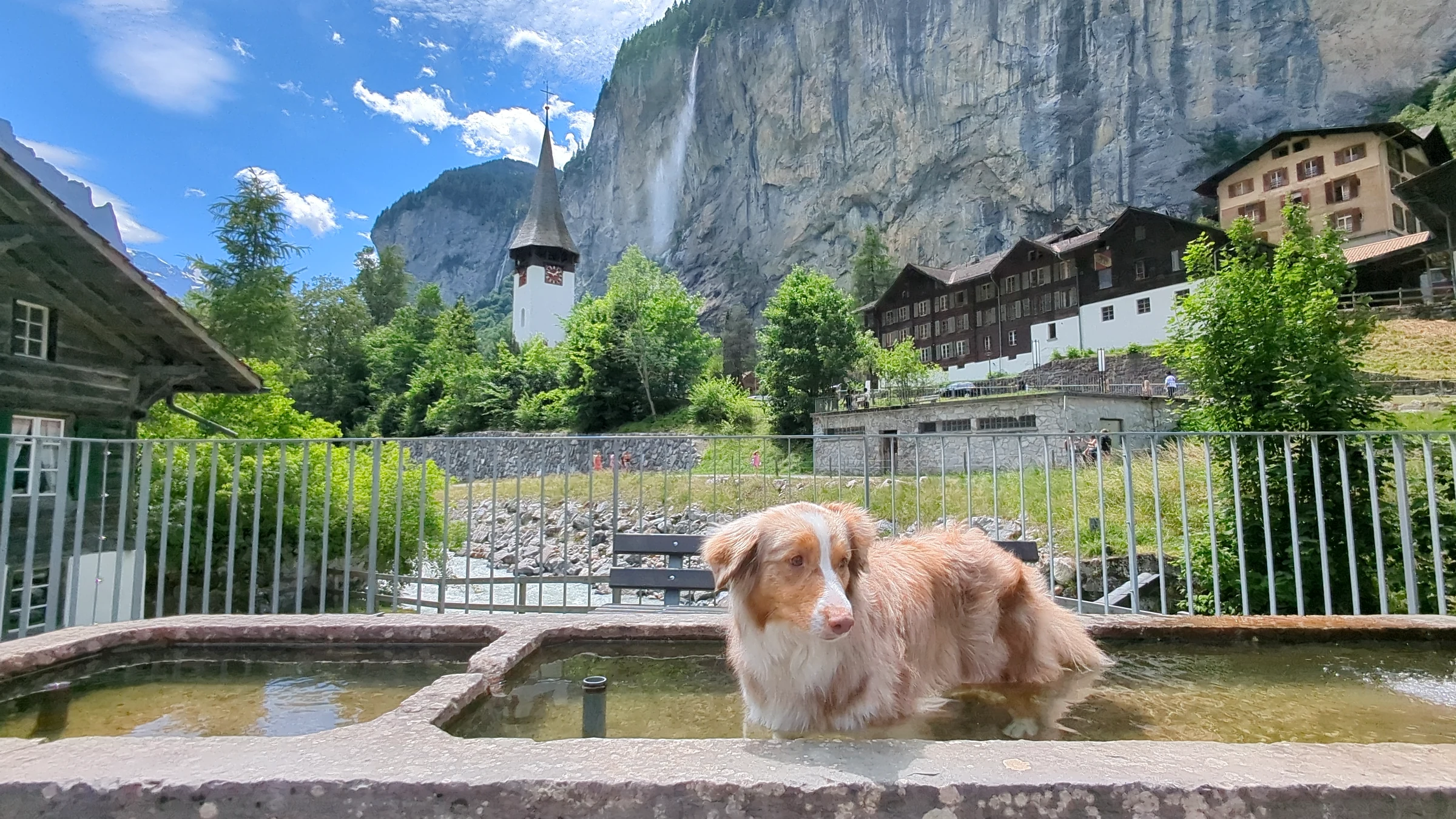
Miley came with us through the village. The highlight for a dog is not the waterfall but the stone fountain next to the church. On a warm July day Miley climbed straight in and lay down in the cold water, with the church and the falls in the background. That photo became one of our favourites of the whole trip. The gallery is narrow, so with a dog pick a quiet moment. For more dog-friendly ideas, see our guide to Switzerland with a dog.
Our afternoon at the falls
We visited on July 6, 2026, a warm, sunny day with blue sky and big white clouds. We had been at the Trümmelbach Falls in the morning and came to Lauterbrunnen at lunchtime. This is how our afternoon went:
- 11:44: parked in the Parkhaus Lauterbrunnen, picked up a village map at the tourist office.
- 12:40 to 13:00: photos at the foot of the village, with the flags and chalets.
- 13:00: a look inside the church, then the classic photo of tower and waterfall.
- 13:45: break at the fountain, Miley in the water.
- 14:00 to 14:20: across the meadow, past the Goethe plaque and up to the Staubbachhubel.
- 14:22: through the tunnel and up the stairs.
- 14:29: in the gallery, view down the valley.
- 14:38 to 14:45: in the spray below the falls.
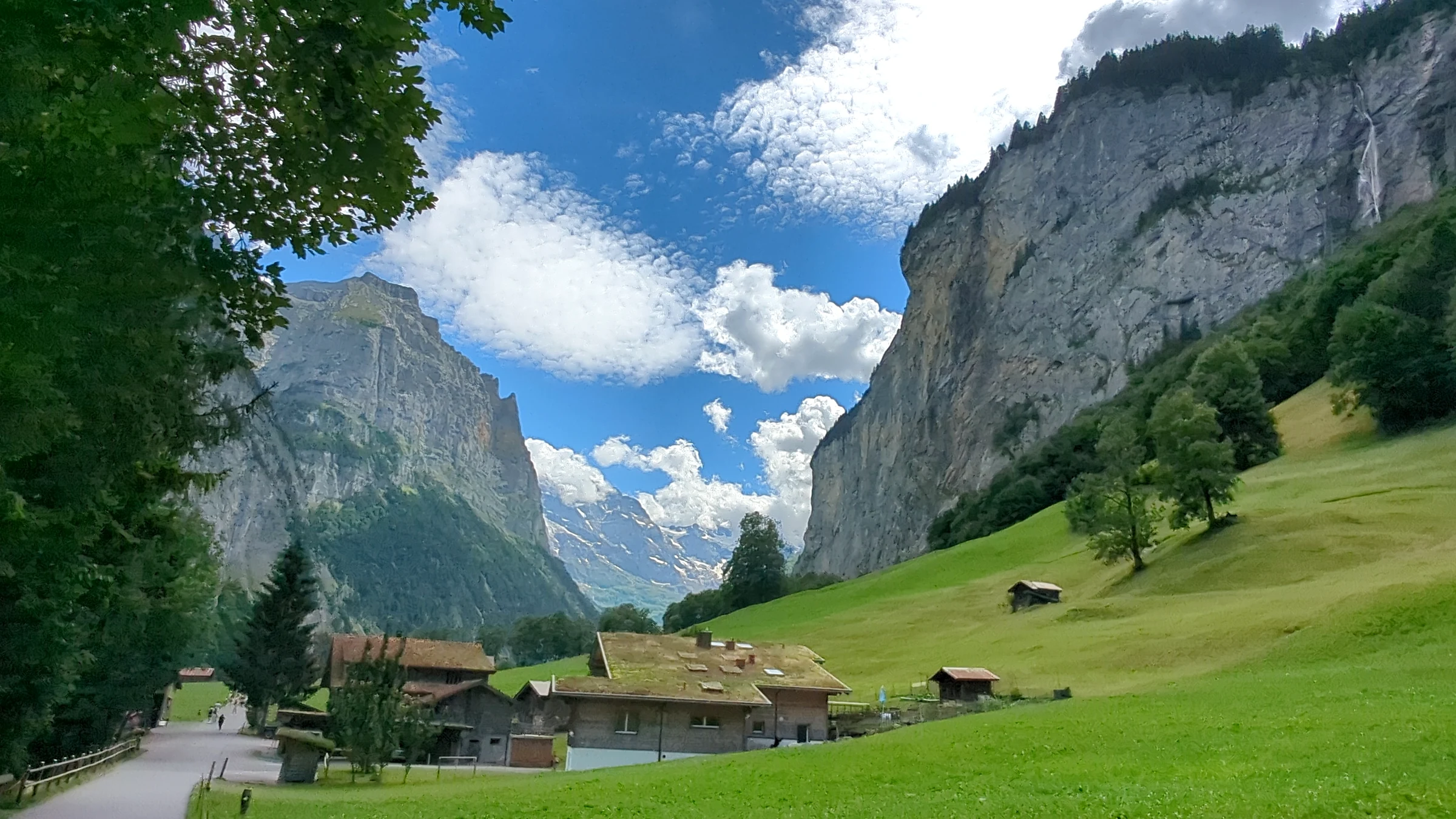
- 15:05 to 15:30: a walk along the meadows deeper into the valley, with more small waterfalls on the cliffs.
- 16:00: back on the main street, now crowded.
Looking back, we would do the gallery first and the village photos afterwards, because the light on the falls was best around midday and the walk up is more pleasant with fewer people.
What to combine it with
Staubbach Falls fills a morning or an afternoon, so combine it with another stop in the valley.
- Trümmelbach Falls: the complete opposite of Staubbach, ten glacier waterfalls inside the rock, a few minutes up the valley. Our guide to the Trümmelbach waterfalls has prices and opening times.
- Mürren: the car-free village on the cliff above the falls, reached by cable car and train from Lauterbrunnen. Our guide to Mürren has the details.
- Schilthorn: the summit with the James Bond history, from Stechelberg or via Mürren.
- Valley walk: the flat path along the river towards Stechelberg passes more waterfalls. We walked part of it after the gallery, and it was much quieter than the village.
If waterfalls and gorges are your thing, our overview of the best gorges and waterfalls in the Bernese Oberland puts Staubbach in context with Trümmelbach, the Aare Gorge and Rosenlaui.
Tips from our visit
- Bring a lens cloth. The spray reaches far, and your phone or camera will be wet within seconds near the gallery.
- Wear shoes with grip. The steps near the top are wet and can be slippery.
- Go early or late. From midday the village and the path get busy.
- Do not skip the church. It takes five minutes, and it is the quietest place in the village.
- Mind the tunnel lights. They are off between 20:00 and 8:00.
- Check the flow. In a dry late summer the falls can be thin. After rain they are at their best.
Tours and tickets
You do not need a ticket for Staubbach Falls. If you travel without a car and want transport and a guide, several day tours from Interlaken stop at the falls, often combined with Trümmelbach, Mürren or Grindelwald. These are the ones we would look at:
About 7 hours, includes Staubbach Falls and Mürren
Check prices & availability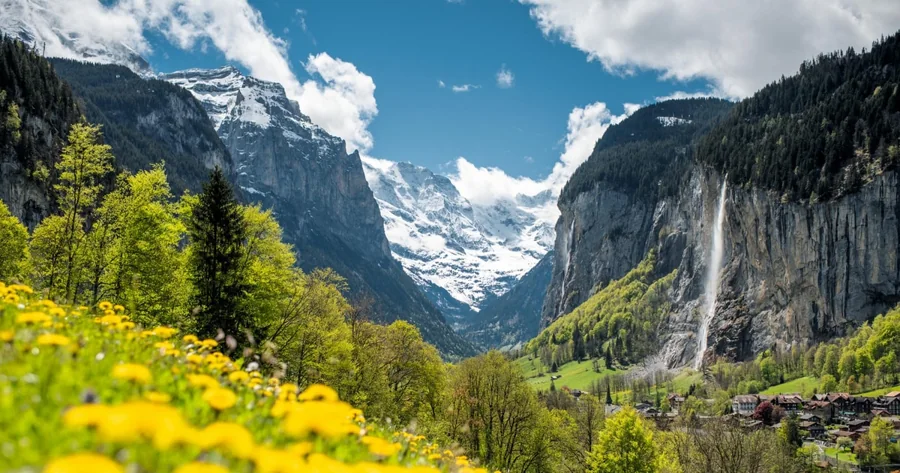
7 hours, optional 30-minute walk at Staubbach Falls
Check prices & availability
6 hours by e-bike, stop at Staubbach, Trümmelbach entry included
Check prices & availabilityFAQ: Staubbach Falls
Is Staubbach Falls free?
Yes. There is no entrance fee for the falls, the path or the gallery. You only pay for parking if you come by car.
How long is the walk to Staubbach Falls?
About ten minutes from Lauterbrunnen station to the foot of the falls. The climb up to the gallery and back takes another 30 minutes or so.
Can you walk behind Staubbach Falls?
Yes, from May to October, via a path with a tunnel and stairs to a gallery in the rock niche behind the falling water.
Is Staubbach Falls lit up at night?
Yes, in summer the falls are illuminated in the evening. Note that the tunnel on the gallery path is not lit between 20:00 and 8:00.
Staubbach or Trümmelbach Falls?
Do both if you can. Staubbach is free and gives you the classic view; Trümmelbach costs an entrance fee and shows you a glacier river inside the mountain. They are only a few kilometres apart.
When does Staubbach Falls have the most water?
From late spring to early summer, when the snow melts, and after heavy rain. In dry late summers the flow can be weak.
Staubbach Falls is the easiest highlight of the Lauterbrunnen Valley: free, ten minutes from the station and impressive at any time of day. For parking, the village and the rest of the valley, continue with our Lauterbrunnen Valley hub. More detours across the Bernese Oberland are on our Switzerland home page.